Arts & Entertainment
'Last Train Home': Chinese Film Shows Largest Annual Migration on Earth (VIDEO)
Film encapsulates the social impacts on 130 million migrant workers who have been separated from their families for decades due to financial necessity.
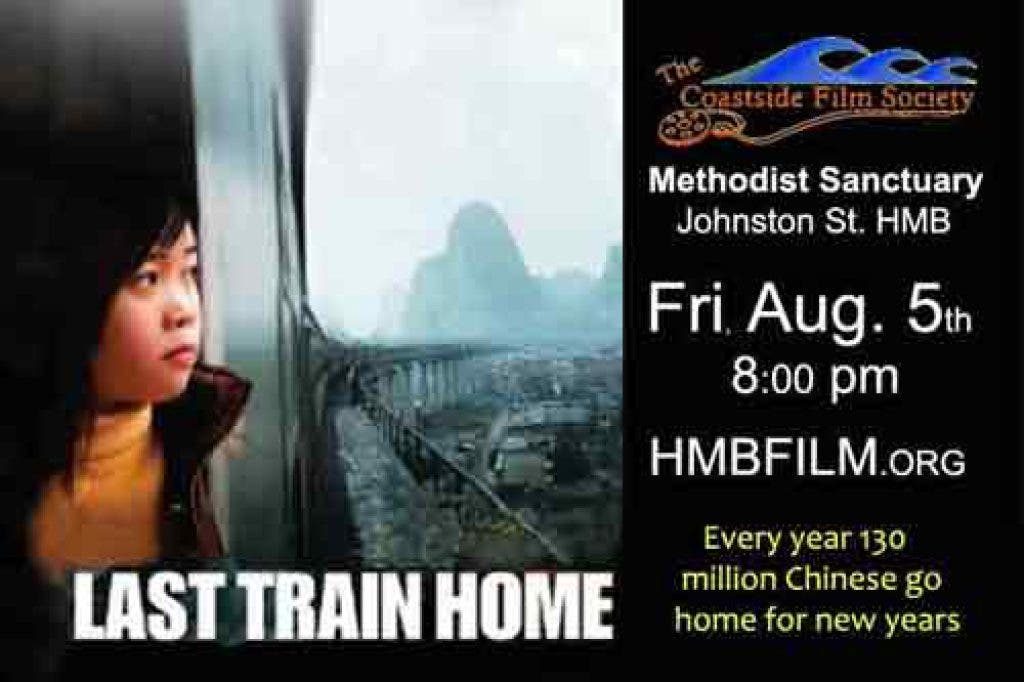

It's something that every Chinese person familiar with their cultural roots knows all too well: When it's Lunar New Year, it's time to come home.
No matter the distance that separates family members — be it 30 miles or 300 miles — they gather together every year for a celebration just as important as Thanksgiving in America.
The tradition endures in China, a country of over 1.3 billion people. With a lack of jobs and opportunity in the country's rural areas, millions of people have had to leave their homes in small towns and villages for paid work over the last few decades. They relocate to cities and towns such as Shenzen in the southern province of Guangdong and join other factory workers that must reconcile making a home away from those they love.
Find out what's happening in Half Moon Baywith free, real-time updates from Patch.
While Chinese Americans can book a plane ticket or take a trip across the bay for an evening, the journey home for those in China is not so easy.
For the country's estimated 130 million migrant workers, getting home involves not just a long train ride, but navigating through the massive crowds of fellow workers seeking to make it home for the holiday. It also can be financially taxing. For many, New Year's is the only time they come home for a visit all year.
Find out what's happening in Half Moon Baywith free, real-time updates from Patch.
The struggle around getting home for New Year's — used as a vehicle to illustrate the social challenges that surround a country of migrant workers separated from their children and local communities by necessity — is the subject of , a documentary released in 2010 by Chinese Canadian filmmaker Lixin Fan.
The film is showing tonight in Half Moon Bay at a screening organized by the .
Jenny Lau, a film professor at San Francisco State who specializes in Chinese cinema, postmodernism, and postcolonial cinema, will be introducing the film at tonight's screening, as well as conducting a audience discussion afterwards. Her interest in film, she says, stems from an interest in the medium's social and cultural impact on society.
Half Moon Bay Patch caught up with Lau earlier this week to talk with her more about the film and its significance in a greater context.
Half Moon Bay Patch: You recommended "Last Train Home" to the Coastside Film Society as a film worth showing. What makes it worth viewing?
Lau: This is such an excellent, excellent documentary film. They used cinema verité [a style of documentary filmmaking that aims to capture "truth" to the extent that is possible with the presence of a camera and filmmaker]. It's absolutely stunning. The filmmaker (Lixing Fan) got every single valuable moment, he didn't miss anything. I always wonder how did he shoot it because the film is about 130 million Chinese. Every spring, for the Chinese New Year's festival, all the rural workers come home. So there 130 million people trying to catch this train all over China over the course of a week. He's shooting the crowd.
He follows a worker home and then things happen in the house when they reunite with their family.
The film is about this couple who have to leave their home to go to the city to get a job and send money to raise their kids. They're separated from them, and the only time they go home is over New Year's — for 20 years.
The kids grew up outside of their parents and were raised by relatives. That is a tremendous hardship for a family.
Half Moon Bay Patch: How did the filmmaker go about finding the people he wanted to focus on?
Lau: He was living in China and is Chinese but has immigrated to Canada. I think he just traveled to China, went into the factories and got to know people and so on. Some people are more open and they made friends with him and he just went from there. He's quite amazing. The film was made with support from the Canadian Film Board.
Half Moon Bay Patch: What does the film say about Chinese society today?
Lau: The film reflects such a major issue in China's moving towards the second-largest world economy. It shows the kind of sacrifice and hardship that people are living under just to push the economy forward. These kinds of sacrifices have never been mentioned in the media or anywhere, so that's why I think it's such an important film.
This is going on with millions of people, not just this family. You can imagine all sorts of issues when kids have no parents growing up. The parents work to give them better education. The parents made all these sacrifices work and worked for 20 years under extreme conditions. That's the whole reason they do so, because they want a better future for their kids.
The children see it differently from their side. Having no parents at home, they grew up with problems. They didn't grow up with high aspirations. They didn't become successful — a whole generation of people. The kids didn't understand the parents and they would have problems with the kids when they came home.
Half Moon Bay Patch: Are there parts of the film that stand out to you?
Lau: When the parents started this [working in a factory away from home], they were in their mid-20s. You know the working conditions. Their only hope is to see their kids succeed. They pour their life into their kids.
Then their kids became angry at them. The film shows those confrontations. There was a scene that was so incredible and he [filmmaker Fan] got it all. When he came to SF to promote the film, we asked him "How do you shoot a scene like this?"
I was glad to hear that he's a filmmaker with high sense of ethics. You can't just keep shooting. At some point you have to intervene and he did. When you do, you sacrifice what's attractive to your audience, ethically speaking. You have to make a choice, so I appreciate it.
"Last Train Home" will screen at the in Half Moon Bay at 8 p.m. on August 5 (tonight). Address: 777 Miramontes Street. San Francisco State cinema professor Jenny Lau will introduce the film, as well as moderate a discussion with the audience afterwards.
To receive news feeds about Half Moon Bay and the unincorporated Coastside between Montara and Pescadero, visit Half Moon Bay Patch on Facebook and "like" us here. Follow us on Twitter here.